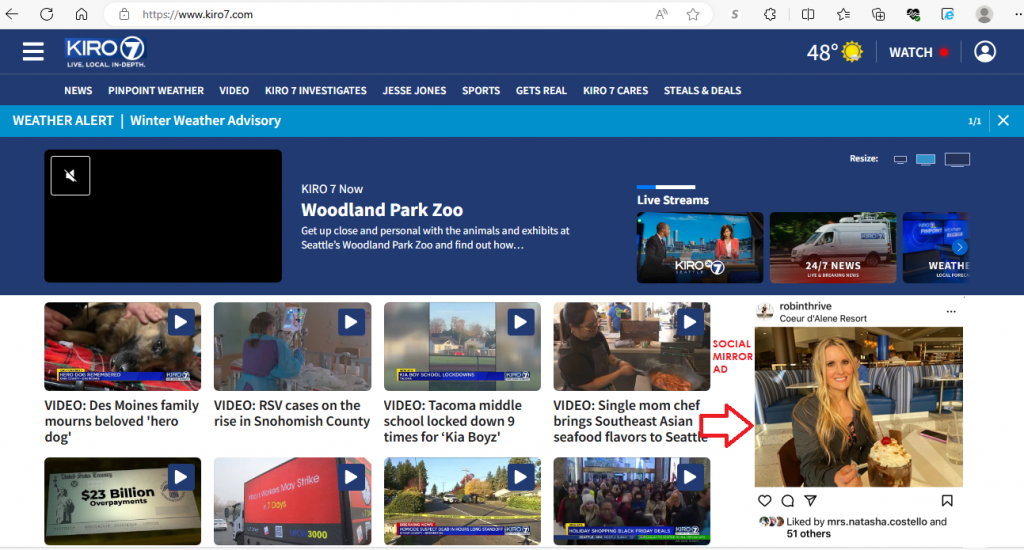

In the 2027 digital marketing landscape, navigating social media advertising is more complex than ever. With platform fragmentation, skyrocketing ad costs within traditional networks, and the rise of decentralized spaces, choosing where to allocate your budget can feel like a moving target. But you must know about social mirroring ads in 2027. Here’s a media buyer’s tip for you to knock the socks off your boss this year.
Between managing separate campaigns for Instagram, TikTok, Threads, and YouTube, creative teams are stretched thin while ad performance faces data tracking limitations. However, a highly sophisticated programmatic solution has evolved to solve this multi-platform dilemma entirely: Social Mirroring Ads.
What Are Social Mirroring Ads?
Social Mirror Ads replicate the exact real-time look and layout of your social media posts and run them as premium programmatic display, video, or carousel placements across thousands of high-traffic websites and mobile apps.
The defining feature? These ads do not run on the social media platforms themselves.
Instead, they use advanced programmatic distribution across the open web to bypass the strict, increasingly expensive “walled gardens” of the major social networks. This allows your brand to retain the high-engagement user interface of social media while gaining access to cross-device targeting data, independent verification, and significantly lower inventory costs.
The Modern Multi-Platform Integration
Today’s social mirror campaigns seamlessly adapt to the design aesthetics of major networks, including:
- Instagram and Facebook
- TikTok and YouTube Shorts (Vertical Video)
- LinkedIn and X (formerly Twitter)
- Pinterest and Snapchat
Whether your best-performing organic or paid creative is a short-form vertical video, a multi-image carousel, or a text-heavy B2B thought leadership piece, the technology perfectly mirrors the platform’s native UX across the broader open web.
How It Works
Deploying a Social Mirror Ad requires zero complex redesigns:
- Identify Performance: Select an organic post or paid ad that is already proving successful on your social channels.
- Provide the Link: Input the direct URL of the post into your programmatic campaign platform.
- Automated Rendering: The software automatically extracts the media, caption text, logos, and interactive elements, encoding them into a responsive web ad format that scales dynamically across mobile, desktop, and tablet screens.
Triple-Threat Call-to-Action (CTA) Framework
Social Mirroring Ads consistently outperform standard banners because they provide three independent, user-friendly click paths within a single creative layout:
- Brand Authority: Clicks on your profile image or the platform logo route users directly to your official brand page on that social network.
- Direct Conversion: Clicks on the main “Shop Now,” “Learn More,” or custom Call-to-Action button drive traffic straight to your chosen website landing page.
- Social Engagement: Clicks on the social engagement icons (like, comment, or share symbols) direct users straight to the live, native post on your social channel to accumulate permanent social proof.
Privacy-First Targeting Strategies for 2027
With cookie deprecation fully realized and privacy regulations reshaping data collection, Social Mirroring Ads utilize advanced, compliance-friendly targeting engines to hit your exact demographic:
- Predictive AI Targeting: Machine learning models analyze real-time context and user engagement patterns to place ads in front of high-intent consumers without relying on legacy tracking.
- Deep Contextual and Keyword Targeting: Aligning your mirrored ads with highly specific webpage topics, streaming content, and article keywords that match your product or service.
- First-Party Retargeting: Clean-room compliant retargeting that gently re-engages users who have previously visited your site as they browse external apps and publications.
- Advanced Behavioral Cohorts: Aggregating authenticated user interest segments across premium publisher networks to maintain razor-sharp demographic precision.
Performance Benchmark Metrics
Because these ads look like trusted, native social posts rather than disruptive banners, they bypass “banner blindness.” Social Mirroring Campaigns frequently achieve click-through rates (CTRs) that surpass the national display ad average by up to 7x. Furthermore, because open-web programmatic CPMs are historically more cost-effective than tight social network bids, the cost-per-acquisition (CPA) is significantly optimized.
Conclusion
As we look deeper into 2027, winning brands are those that liberate their best content from the limitations of individual social networks. Social Mirroring Ads allow you to amplify your creative investments, leverage sophisticated open-web data, and scale your brand presence across the internet with absolute simplicity.
Why limit your best content to a single feed when you can mirror it across the entire web? Connect with our media buying team today to launch your next high-performance Social Mirror Campaign.
An example of our own social mirroring ad below: